

Global Goal 13: Climate Action
by Becca Todd, United Kingdom
Description
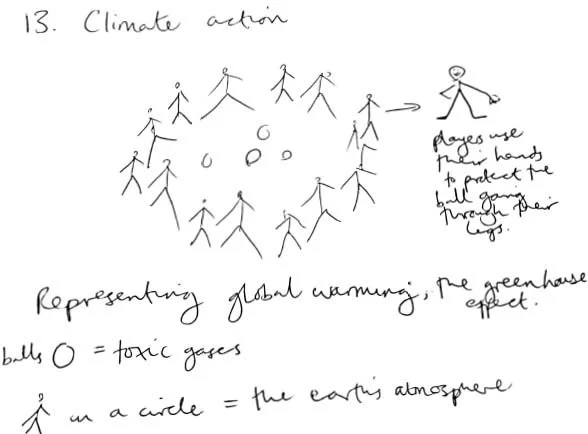
Climate Chaos is a dynamic and educational game that simulates the effects of global warming. By participating in Climate Chaos, players can gain a better understanding of the complex issue of climate change and the importance of taking action to protect our planet.
Form a circle: Players stand in a circle, with their feet spread apart to represent the Earth's protective layer.
Introduce the heat: A ball is introduced as a symbol of heat energy.
Prevent heat escape: Players must work together to keep the ball within the circle, preventing it from "escaping" into the atmosphere.
The impact of pollution: As the game progresses, players can be eliminated to simulate the effects of pollution on the Earth's protective layer.
More Play
-
Increased Difficulty: Players can use fewer limbs to control the ball, making it more challenging to keep the heat contained.
Multiple Heat Sources: Introduce additional balls to represent increased greenhouse gas emissions.
-
Players: An ideal number of players would be between 5-8. This number ensures enough players to form a tight circle, while also providing enough challenge in keeping the "heat" contained.
Material: Balls.
Create Game Situations
Encourage creativity:
Invite players to suggest unique game scenarios and modifications.
Goal-based challenges: Introduce different goals for each team, such as scoring a certain number of goals or completing specific challenges.
Integrating Global Goals:
Goal-based rewards: Implement a system where teams can earn bonus points by stating a Global Goal and how they plan to promote it in their community.
Water break discussions: Use water breaks as opportunities for players to discuss and share their ideas for promoting the Global Goals.
Small-sided games: Encourage players to form smaller teams for easier communication and engagement.
Additional Tips:
Variety is key: Offer a variety of game formats and challenges to keep players engaged.
Flexibility: Be adaptable and willing to adjust the game based on player feedback and preferences.
Community involvement: Encourage players to involve their communities in the game and the Global Goals initiative.